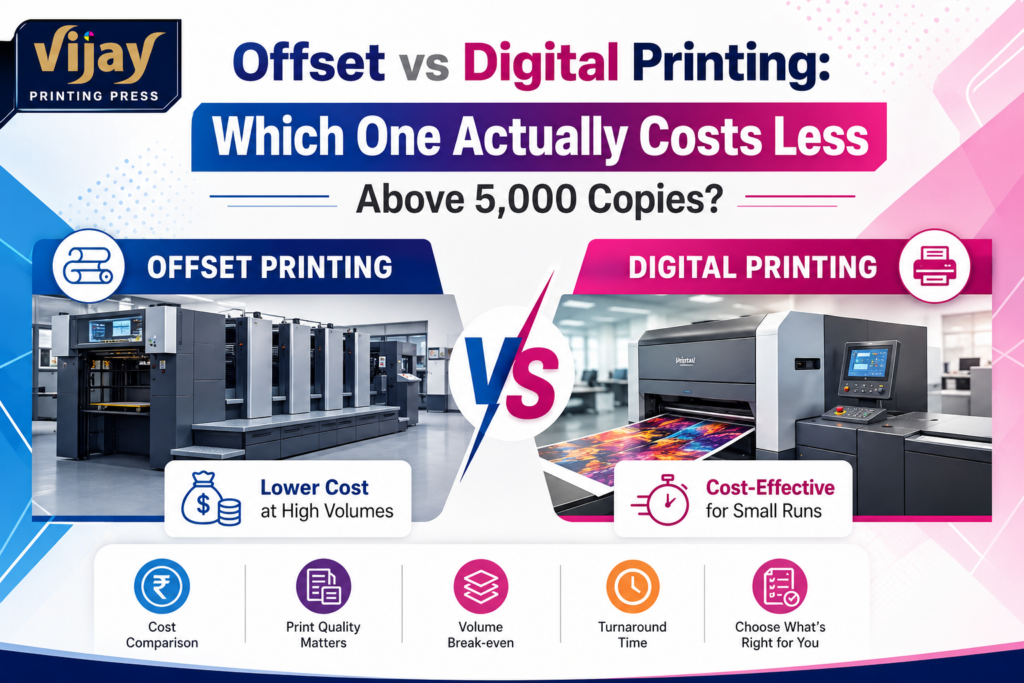
When it comes to offset printing in Indore, one question businesses often ask is whether offset or digital printing offers better value for large print runs. The answer is not as simple as choosing the cheapest printing method. The actual cost depends on quantity, paper selection, colour requirements, finishing, turnaround time and the type of material being printed. While digital printing can be economical for smaller quantities, offset printing often becomes more cost-effective as the volume increases. For businesses ordering 5,000 copies or more, understanding where the cost difference comes from can help avoid unnecessary spending.
Whether you are printing brochures, catalogues, flyers, books, magazines, packaging inserts or corporate stationery, choosing the right printing process can have a direct impact on your overall production budget. The key is to understand how each technology works and when its pricing structure becomes advantageous.
Offset Printing vs Digital Printing: Understanding the Difference
Before comparing costs, it is important to understand what actually happens during each printing process.
Digital printing works much like a highly advanced commercial printer. The digital artwork is sent directly to the printing machine without requiring traditional printing plates. This makes the setup process relatively quick and allows printers to produce smaller quantities efficiently.
Offset printing follows a different process. The artwork is transferred onto printing plates which then transfer the image onto a rubber blanket before it reaches the paper. The initial setup takes more time and involves additional preparation. However, once the press is ready, large quantities can be produced efficiently.
This difference in setup is one of the main reasons digital printing tends to perform well for short runs while offset printing becomes increasingly attractive for larger quantities.
Why Offset Printing Can Cost Less Above 5,000 Copies
At first glance, offset printing can appear more expensive because it involves plate preparation, press setup and other initial production steps. However, these setup costs are distributed across the entire print run.
Imagine producing 500 copies and then producing 5,000 copies. The initial preparation involved in offset printing does not increase tenfold simply because the quantity increases. Once the press is set up, the additional cost of producing each copy can be relatively low.
This creates an important concept in printing economics: economies of scale.
As the number of copies increases, the fixed setup cost becomes a smaller portion of the cost per individual piece. This is why businesses ordering thousands of copies often consider offset printing instead of digital printing.
For high-volume projects, experienced offset printing services can help businesses plan production around quantity and material requirements rather than simply comparing the price of one copy.
Digital Printing: When Is It More Economical?
Digital printing has a major advantage when you do not need thousands of copies.
Since there is no traditional plate-making stage, digital printing can make smaller print runs more practical, which is one reason demand for digital printing in Indore has grown among startups and smaller businesses. It is particularly useful when a business needs a few hundred copies or when the printed content needs to be changed frequently.
For example, imagine a company needs 300 brochures for an upcoming event. Printing 5,000 brochures simply because the per-unit price is lower would not necessarily save money. The company would also have to store the excess inventory.
Digital printing can be useful when:
- The quantity is relatively low
- The project has a tight deadline
- Artwork changes frequently
- Multiple versions are required
- Personalisation is important
- The business wants to avoid excess inventory
This makes digital printing a valuable option rather than simply a competitor to offset printing.
Offset Printing in Indore: Where Large-Volume Printing Makes Sense
For businesses looking for offset printing in Indore, quantity should be one of the first factors discussed with the printing partner.
If you require several thousand identical copies, offset technology may offer better economics because the setup cost is spread across a larger production volume.
Common applications include:
- Corporate brochures
- Product catalogues
- Marketing leaflets
- Books
- Magazines
- Company profiles
- Educational materials
- Calendars
- Promotional materials
- Business stationery
The exact break-even point between digital and offset printing can vary depending on the machine, paper, number of colours, finishing requirements and project specifications. There is no universal rule that says offset becomes cheaper at exactly one particular quantity.
For this reason, businesses should compare quotations based on the complete project rather than focusing only on the printing method. The same applies when comparing commercial printing services in Indore, where quotations for identical jobs can vary widely between presses.
What Actually Determines Printing Cost?
The number of copies is important but it is not the only factor affecting the final price.
1. Print Quantity
Quantity has one of the strongest effects on the economics of printing.
For digital printing, each additional copy generally adds a relatively consistent production cost. Offset printing has higher initial preparation costs but can achieve a lower per-copy cost as volume increases.
This is why a 5,000-copy project needs to be evaluated differently from a 500-copy project.
2. Paper Selection
Paper can significantly influence the total project cost.
Different projects may require:
- Matte paper
- Gloss paper
- Uncoated paper
- Textured paper
- Recycled paper
- Premium coated stock
- Speciality paper
Choosing an unnecessarily expensive paper can increase the budget without necessarily improving the customer’s experience. At the same time, selecting paper purely on price can compromise the appearance or durability of the finished product.
The right paper should match the purpose of the printed material.
3. Number of Colours
Full-colour printing generally involves different production considerations compared with one-colour or limited-colour projects.
Offset printing is particularly effective for consistent high-volume colour reproduction. When thousands of copies need to maintain the same visual appearance, press calibration and colour management become important considerations.
4. Finishing Requirements
Printing is only one part of the production process.
Finishing may include:
- Lamination
- Folding
- Cutting
- Binding
- Creasing
- Perforation
- Spot UV
- Embossing
- Die cutting
A project with extensive finishing can cost significantly more than a basic printed sheet. Therefore, businesses should compare the complete finished product cost rather than the printing rate alone.
Offset Printing Services for Commercial Printing Projects
Businesses that regularly produce large volumes of marketing materials often rely on commercial printing services for consistent production.
Commercial printing is not limited to putting ink on paper. It involves planning the complete production workflow from artwork preparation through printing, finishing and final delivery.
For large orders, consistency becomes particularly important. If 5,000 brochures are being produced, differences in colour, trimming or folding can affect the final presentation.
Professional production planning helps reduce these issues.
At Vijay Printing Press, businesses can evaluate their project requirements based on quantity, material and finishing requirements before selecting an appropriate printing process. This type of consultation can be particularly useful for large-volume projects where a small difference in per-copy pricing can have a meaningful impact on the total budget.
Why Quality Should Not Be Ignored When Comparing Costs
It is tempting to compare printing quotations only by looking at the final number. However, the lowest quotation is not always the lowest overall cost.
Consider a catalogue that will represent a company’s products for an entire sales season. If the paper quality is unsuitable, colours are inconsistent or finishing is poor, the business may end up with material that does not represent the brand effectively.
A better approach is to evaluate:
Total cost + quality + consistency + suitability + turnaround time
This provides a more realistic picture of value.
For high-volume printing, consistency can be particularly important because the same design may need to be reproduced thousands of times.
Bulk Printing Services: Planning Before You Print
When ordering through bulk printing services, preparation can have a significant impact on both cost and production efficiency.
Before sending a large project for production, businesses should finalise:
- Final artwork
- Number of copies
- Paper specifications
- Page size
- Colour requirements
- Finishing requirements
- Packaging requirements
- Delivery schedule
Artwork changes after production has started can create delays and additional expenses. This is especially important for offset printing because the press setup involves more preparation than digital printing.
A physical proof or approved sample can also be useful for important projects. It gives the client an opportunity to review colour, layout, paper and finishing before the complete order is produced.
Offset Printing Press Indore: What Should You Look For?
When searching for an offset printing press in Indore, businesses should look beyond basic pricing.
A reliable printing partner should have an understanding of:
Printing Technology
The equipment used for production can influence quality, speed and consistency. Businesses should consider whether the printer has suitable machinery for the size and volume of their project.
Colour Management
Consistent colour reproduction matters when printed materials are part of a company’s branding. The printer should have appropriate processes for maintaining consistency throughout the production run.
Material Knowledge
A professional printer should be able to discuss paper options and explain how different materials may affect the final result.
Finishing Capabilities
If your project requires folding, binding, lamination or other finishing processes, it is useful to understand whether these can be managed as part of the same production workflow.
Production Planning
Large orders require proper scheduling. A printer should be able to communicate realistic production timelines and identify potential issues before they affect delivery.
Offset or Digital: A Practical Cost Comparison
The simplest way to understand the difference is to consider different project scenarios.
Scenario 1: 300 Brochures
For 300 brochures, digital printing may make more financial sense because the project avoids the setup costs associated with offset printing.
Scenario 2: 2,000 Brochures
At 2,000 copies, the difference becomes less straightforward. Paper, colour, finishing and machine rates need to be considered before making a decision.
Scenario 3: 5,000 Brochures
At 5,000 copies, offset printing becomes a strong option for evaluation. The initial setup cost is distributed across thousands of copies, which can significantly reduce the effective cost per piece.
Scenario 4: 20,000 Copies
At very high volumes, offset printing can become particularly efficient when the artwork is identical across the complete production run.
These examples demonstrate why there is no single printing method that is always cheaper. Quantity changes the economics of the project.
How Businesses Can Reduce Their Printing Costs
Choosing the right technology is only one way to control printing expenses.
Businesses can also reduce costs by planning print requirements in advance.
Print the Right Quantity
Do not automatically order more copies than you can realistically use. A lower per-unit price does not represent savings if thousands of printed materials eventually become obsolete.
Standardise Materials
Using standard paper sizes and commonly available materials can sometimes simplify production and reduce unnecessary costs.
Finalise Artwork Early
Making sure the artwork is completely approved before production can help prevent reprints and production delays.
Combine Production Requirements
If a business regularly needs the same type of printed material, planning larger production batches may improve overall efficiency where storage and demand make it practical.
Discuss the Project With the Printer
A good printing partner can often identify opportunities that are not obvious from a basic online price comparison.
So Which One Actually Costs Less Above 5,000 Copies?
For print runs above 5,000 copies, offset printing will often be more cost-effective on a per-copy basis, particularly when the same artwork is being reproduced in large quantities.
However, that does not mean offset is automatically the cheapest choice for every project. Paper selection, colour requirements, finishing, format and production specifications can all change the final calculation.
Digital printing remains valuable when quantities are smaller, deadlines are short or personalisation is required.
The smarter approach is to compare both options based on the complete project requirements.
For businesses seeking offset printing in Indore, this distinction is particularly important. Instead of asking only “What is the price per copy?” ask “What is the total cost for the finished product that meets my requirements?”
That question produces a much more useful comparison.
Conclusion
The choice between offset and digital printing should be based on volume, purpose and overall production requirements rather than a simple assumption that one technology is always cheaper.
Digital printing offers flexibility and efficiency for shorter runs while offset printing can deliver stronger economies of scale for thousands of identical copies. Once a project reaches 5,000 copies or more, offset printing deserves serious consideration because the initial setup cost can be distributed across a much larger production volume.
For brochures, catalogues, books, marketing materials and other high-volume projects, the right printing method can make a noticeable difference to both budget and quality.
Vijay Printing Press helps businesses approach commercial printing with a focus on quality, consistency and practical production requirements. Whether the project requires a short digital run or high-volume offset production, selecting the right process at the beginning can help businesses achieve better value from their printing investment.
Ultimately, the cheapest printing method is not necessarily the one with the lowest quoted rate. It is the method that delivers the required quantity, quality and finish at the right overall cost.